My Books on Amazon





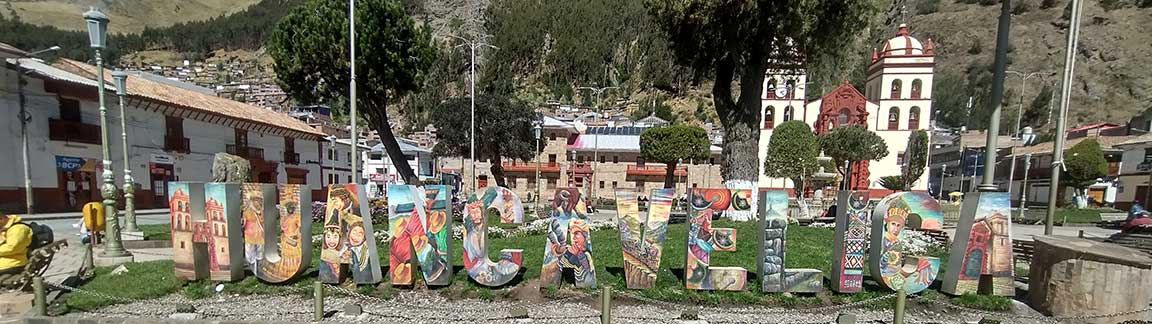
Huancavelica: Life at 3,704 Meters, that's more than 12,000 feet
March 24, 2026
Huancavelica, Perú, sits at 3,704 meters (12,093 feet), on average. If my memory is right, that puts it slightly higher than the summit of Mt. Hood in Oregon. My brain is certainly aware of the difference. The last time I was here, a little over a year ago, the altitude pressed in from all sides: a little dizziness, a mild headache, and that strange foggy feeling that comes when the air refuses to give your lungs quite what they’re asking for. When I lived in Arequipa, Perú (average elevation 2,328 meters / 7,638 feet), I felt like this every single day for the first six months. It was not a pleasant adjustment. Walking up even a modest hill here feels like climbing a staircase that never quite ends. But this time, no mild headache, no dizziness. I think my brain has finally decided to live with the elevation.
It’s also cold. Afternoon highs are generally around 17° C (63° F), and locals told me that’s more or less typical throughout the year. The sun can feel warm when it’s shining directly on you, but the moment a cloud passes or a breeze slips down from the surrounding mountains, the chill returns. Despite the cold and the altitude, the setting is quite beautiful. The city lies in a high and narrow Andean valley, with the Mantaro River threading its way through the center of town. The mountains rise steeply on all sides, giving the place a sheltered, almost tucked-away feeling, as though the town is quietly minding its own business far above the rest of the world.
Centuries of History
Huancavelica has a population of roughly 50,000 people and a long history tied closely to the Spanish colonial period. The town was officially founded in August of 1572, during the rule of Viceroy Francisco de Toledo, who played a major role in consolidating Spanish authority throughout the region. Construction of the main church began that same year and continued until its completion in 1603. Walking through the city today, you can still see several churches and colonial-era buildings that date back centuries. Many of them remain in active use, which gives the historic center a sense of continuity with the past. The architecture is not grand in the way of larger colonial cities like Cusco or Arequipa, but it carries a certain quiet dignity that reflects its long history.
Despite that history, Huancavelica today is considered one of the poorest cities in Perú. Economic opportunities here are limited, and much of the surrounding region is rural and agricultural. Life moves at a slower pace than in the larger Peruvian cities, and the infrastructure reflects that. At the same time, the town retains a strong local culture and identity rooted in its Andean heritage.
Long before the Spanish arrived, the area was known as Wankawillka, which roughly translates to “sacred stone.” Indigenous communities had lived in this region for centuries, and the name reflects the spiritual significance the landscape held for them. When the Spanish established the colonial town, they did so largely because of what lay hidden in the surrounding mountains. The region became famous for its mines, particularly those producing mercury, also known historically as quicksilver. This resource was extremely valuable during the colonial period because mercury was used in the process of extracting silver from ore. The mines of Huancavelica became one of the most important mercury sources in the Spanish Empire, linking this remote Andean town to the vast silver economy that stretched from Perú to Spain and beyond.
The Space Connection
Huancavelica also has an unusual connection to space exploration. In 1977, NASA launched the Voyager 1 and Voyager 2 spacecraft, each carrying a Golden Record intended as a message from Earth to any possible extraterrestrial civilizations. Among the many sounds and pieces of music included on that record is a traditional wedding song from this region of Perú. The recording features a young girl singing a local folk melody. That simple voice, captured nearly half a century ago in the Andes, is now traveling through interstellar space aboard both Voyager probes. Somewhere far beyond our solar system, Huancavelica’s music is still drifting outward into the universe.
The Mining Industry
Here's something interesting: Huancavelica has a strong mining industry in the surrounding mountains, yet you see no evidence of it in the city. Compare that to Cerro del Pasco, which has monuments to miners, and the city is very polluted because of the mining.
That contrast is actually one of the most interesting things about Huancavelica.
Even though the mountains surrounding the city have a long mining history, the activity feels strangely invisible when you’re actually walking through town. You don’t see heavy mining infrastructure dominating the skyline, no large tailings piles are looming over neighborhoods, and there’s little visual reminder that the region once supplied one of the most important minerals in the Spanish Empire. Huancavelica looks and feels like a quiet highland provincial town, not a mining center.
That’s very different from Cerro de Pasco, where the mining presence is impossible to ignore. The enormous open-pit mine literally sits in the middle of the city, reshaping the landscape and the urban layout. Cerro de Pasco even has monuments dedicated to miners, acknowledging how central the industry is to the identity of the city. Unfortunately, the mining has also brought severe environmental consequences. Cerro de Pasco has long struggled with heavy metal contamination, polluted soil and water, and widespread health concerns among residents. Because of these issues, the Peruvian government has periodically discussed plans to relocate large parts of the population to a new city outside the contaminated zone.
Huancavelica, by comparison, tells a quieter story. Historically, its importance came from mercury mining, especially from the famous Santa Bárbara Mine, sometimes called “the mine of death” during the colonial era because of the brutal labor conditions endured by Indigenous workers. But most of that large-scale extraction declined long ago. What remains today is more scattered and less visually dominant than the massive industrial operations that define Cerro de Pasco.
So walking through Huancavelica today can feel a bit puzzling. You know the surrounding mountains contain centuries of mining history, yet the city itself feels almost detached from it. Instead of smokestacks and mine pits, what you notice are churches from the 1500s, narrow streets, small plazas, and the slow rhythm of life in a high Andean valley. It’s a rare case where the economic history of a place sits mostly out of sight, hidden in the mountains rather than stamped across the city itself.
The Colonial History is Still Here
Huancavelica has another characteristic that immediately stands out once you begin wandering around the center of town: the streets are narrow. Very narrow. In many places, they feel more like passageways than streets, especially the little connectors that run between the main roads. These slim corridors weave between blocks like shortcuts locals have known for generations. Some are just wide enough for two people to pass each other comfortably. Others feel like something halfway between an alley and a walkway, quietly threading through the old colonial layout of the city.
Even the main streets aren’t particularly wide. Many of them date back centuries, long before anyone imagined buses, trucks, or even steady automobile traffic squeezing through them. In several places, the “sidewalk” is little more than a raised strip of concrete about a foot wide. Walking along one of these while a car passes requires a small act of choreography: step carefully onto the narrow edge, flatten yourself against the wall, and wait a moment for the vehicle to creep by. It’s a reminder that this town was built for people on foot and perhaps the occasional horse, not modern traffic.
A Pedestrian-Friendly Town
In the past year, the city has made an interesting change that seems to acknowledge exactly that. Avenida Celestino Muñoz, which runs from the Plaza Mayor up to Plaza Santa Ana, about 5 blocks, has been closed to vehicle traffic. What used to be a narrow street filled with cars and mototaxis has been turned into a pedestrian-only corridor. The transformation is noticeable. Without vehicles squeezing through, the street suddenly feels larger, calmer, and far more pleasant to walk along. People stroll and skate freely, children wander without being constantly pulled aside by parents, and the storefronts feel more open to the flow of pedestrians.
The pedestrian focus doesn’t stop there. All four sides of the Plaza Mayor itself are closed to vehicles, as are the streets that approach it. The result is that most of the historic city center has effectively become a pedestrian zone. You can walk from one end of the central district to the other without constantly worrying about traffic. It changes the atmosphere of the place in subtle but important ways. Instead of engines and horns dominating the soundscape, you hear conversation, footsteps on stone, and the everyday rhythm of people simply moving through their town.
For a city whose streets were designed centuries ago for foot traffic, the shift feels natural. Rather than forcing modern traffic into spaces that were never meant for it, Huancavelica has quietly returned the historic center to its original purpose: a place meant primarily for people, not vehicles.
The Malecon
Huancavelica, for such a small town, has done a very nice job of surrounding the river, on both sides, with park space and wide paths. There's an exercise area, a small futbol (soccer) field, a basketball court, a playground, and a pedestrian bridge midway between the two vehicle bridges. This sort of malecon is rare for most towns, especially for small towns.
The Viewpoint
There's a high viewpoint called Senor de Oropesa directly above the city. Getting up to it requires either a taxi or walking/climbing a 2-kilometer stairway. Two kilometers of stairs! At 3880+ meters. It wasn't easy.
If you climb that stairway up the mountainside, a couple of things jump out immediately.
- First, that valley. From the wide overlook shot, you can really see how Huancavelica is squeezed into a tight Andean corridor. The city spreads along the valley floor, almost like someone poured a box of buildings between two walls of mountains and let them settle where they landed. The Mantaro River winds right through the middle, and you can see how the urban area simply follows the available flat land. Once the valley floor runs out, the mountains immediately take over.
- Second, that stairway. Two kilometers of steps at roughly 3,800–3,900 meters (12,500 - 12,800 feet) is no small joke. At that altitude, you’re dealing with roughly 60–65% of the oxygen pressure you’d have at sea level. That means every climb feels like you’re wearing a backpack full of invisible bricks. Stopping every five minutes isn’t a weakness; it’s physics.
The path itself is nicely done. The stonework and the retaining walls suggest the city intentionally built the route as a formal pilgrimage or viewpoint trail rather than just a dirt scramble up the hillside. There's a little chapel about 3/4 of the way up that reinforces that. Along the route, there are numbered stops - these are the Stations of the Cross. In Catholic tradition, the Stations of the Cross (also called Via Crucis in Spanish) mark the events of Jesus’ walk to the crucifixion. The full devotion traditionally has 14 stations.
I've seen such trails before, in other towns. During Holy Week, they have a procession that walks up to the top. What’s interesting about the one in Huancavelica is the scale. Two kilometers of stairs at nearly 3900 meters makes it one of the more physically demanding versions of a Via Crucis you’ll find. For locals used to the altitude, it’s manageable, but for someone coming from lower elevations, it turns the devotional walk into something that feels halfway between a pilgrimage and a mountain workout.
High Andes versus Lower Selva Town's Friendliness
And one other point about Huancavelica - the people absolutely do not greet anyone passing in the streets, unless they know the person. In my 3 days there, the number of people who greeted me, both before and after I greeted them, I can count on one hand.
In many smaller towns in Peru, greetings between strangers simply aren’t part of the everyday social rhythm the way they are in other regions. In high Andes towns like Huancavelica, people tend to greet family, friends, neighbors, or coworkers, but not random passersby. To locals, walking past someone silently isn’t considered rude. It’s just neutral behavior.
I experienced the direct opposite in other places in South America. In much of Colombia, Ecuador, and parts of northern Peru (particularly the Amazon region), greeting strangers with “buenos días” or “buenas tardes” is much more common. In those regions, it’s almost a default social lubricant. People acknowledge each other even if they’ve never met before.
The difference often comes down to a few cultural factors:
- Strong in-group social circles
In many highland communities, social life revolves around family networks and long-standing community relationships. People interact warmly within those circles, but strangers are simply outside that sphere. - Historical caution toward outsiders
Regions like Huancavelica have long histories of poverty, mining exploitation, and outside control going back to the colonial era. That sometimes produces a culture that is a bit more reserved with strangers. - Language and cultural background
A large percentage of people in that region speak Quechua as their first language. The social norms around greetings and interaction can be different from Spanish-speaking urban culture.
Urban anonymity
Even though Huancavelica is relatively small, the center still functions like a small city rather than a village. In true rural villages, you may get more greetings because everyone recognizes you as “the outsider.”
This is a small reminder that “friendliness” looks different depending on where you are. A place can feel reserved on the surface while still being perfectly warm once someone actually knows you.

I used to teach English as a foreign language in Barranquilla, Colombia. Now I'm retired and traveling throughout South America.
I'm from Kennewick, Washington, USA. In my previous life, as I call it, I was an IT guy, systems administrator, computer tech, as well as a shipping/receiving guy and also worked as a merchandising guy in a RV/Camping store.