My Books on Amazon






Buenos Aires: Two Days in the Paris of America
October 10, 2026
I arrived in Buenos Aires (Santa María del Buen Aire) via the ferry from Colonia del Sacramento, Uruguay. Buenos Aires is a big city of about 13.4 million. Within that greater metropolitan area is the "smaller" city of Buenos Aires, with about 3.1 million. When I left the ferry terminal and walked to the city center I was rather disappointed in what I walked through. That part of the city is nothing special. Then, as I continued, I passed through some of the historic district, again a bit disappointing - dirty, too many people sleeping on sidewalks. Eventually, I arrived in the city center and things changed a lot - the city became what I expected of BA - very old, clean, and interesting. The city center is loaded with very old buildings and I found to be more interesting than the official historic district. NOTE: You will find people here speak with the Rioplatense accent. This is an accent of Spanish common throughout the greater Buenos Aires area and also heard in Uruguay. If you come across a person with a thick accent, there's a good chance you won't understand them, I sure don't. It's almost as if they're sticking an 'sh' or 'zh' sound between every other syllable. Don't expect to find many who speak a "clean" Spanish, and even fewer who speak English or any other language. I did come across a young woman who speaks very good English, she works in a store that sells wine and other alcohol, but mostly wine. I didn't buy any, and we chatted for a while. I also came across a couple of restaurant servers who attempted to use English, but they were just individual words, not full sentences.
According to Wikipedia1 BA has an "alpha" status among the world's greatest cities2. BA has great influence in commerce, finance, fashion, art, gastronomy, education, entertainment, and especially its distinctive culture. It is also considered one of the twenty-five most influential cities in the world3. The city has quite a mix of influence and it is visible in the architecture: Spanish viceregal, Art Deco, Art Nouveau, Neo-Gothic, Italianate, French Bourbon, and French academic styles are all mixed together. Because of this, along with its building development and European influence on its architecture in certain areas, it is known worldwide by the nickname "The Paris of America."4
A City Founded Twice
The first explorations of this part of the world were in 1516 (Juan Díaz de Solís) and 1527 (Sebastian Cabot). Pedro de Mendoza founded a settlement that he named, "Santa María del Buen Ayre," in February 1536. A local indigenous group of people, the Querandí, provided food for Mendoza and his new community. After two weeks, that stopped and Mendoza sent men to demand more. That led to fighting, including a major battle in June 1536 near the Luján River, followed by a siege and a severe famine inside the settlement. Mendoza, already very ill, sailed for Spain in 1537 and died at sea. The survivors held on for a few more years, but in 1541 Domingo Martínez de Irala ordered the settlement abandoned, and the remaining settlers moved upriver to Asunción, in Paraguay. Nearly forty years later, Juan de Garay came back down the river from Asunción and in June, 1580, founded the "Ciudad de la Santísima Trinidad," with its port named "Santa María de los Buenos Aires." The port's name is the one that stayed.
The site of Mendoza's settlement is disputed. But there is a park, Parque Lezama, in BA that has a statue of him, and some historians say that was the location of his settlement. Then Garay founded what would become Buenos Aires about two kilometers north of that location. This new settlement has very good documentation as the city streets were laid out around a central plaza, Plaza de Mayo.
The Historic District and the Historic District
The official historic district, the Casco Histórico, is mainly San Telmo, near the ferry terminal, and part of Monserrat. That's where the city is oldest in the sense that its street grid and settlement date back to colonial times. But very little colonial architecture survives there. In the 19th century, San Telmo was where wealthy families lived, until the yellow fever epidemic of 1871 drove them north to higher ground in what became Recoleta and Barrio Norte. Their big houses were then divided into conventillos, crowded tenements for the waves of European immigrants arriving at the port. The neighborhood never really recovered its money, which is why it feels worn, with the sidewalk sleepers and grime you described. Its charm is more bohemian: antique shops, the Sunday fair on Defensa, tango in the streets.
The downtown area I liked, around Plaza de Mayo, Avenida de Mayo, and Diagonal Norte, is younger but far grander. Most of it was built between about 1880 and 1930, when Argentina was one of the richest countries in the world on the strength of beef and grain exports. That's when the city hired European architects and built the palaces, domes, and boulevards that earned it the "Paris of America" nickname. The Palacio Municipal, the Edificio Sudamérica, and most of the buildings you photographed come from that boom.
So, going back to the intro paragraph, i wrote about not liking the historic area all that much, and that was the area of San Telmo and a bit of Monserrat.
A Dome or Cupola on almost Every Corner
I noticed one of the city's signature features—Buenos Aires has around 350 domes crowning its buildings, and they're so common that locals have given names to spots like the corner of Diagonal Norte and Florida, called "the corner of the five domes."
There are so many that I thought many buildings had them "just to have one." I wasn't too far off on that thought. During that 1880 to 1930 boom, domes were the city's architectural status symbol. The wealthy elite were copying Paris, where Beaux-Arts buildings often crowned their corners with domes and cupolas, and Argentine banks, insurance companies, newspapers, and department stores wanted their headquarters to look just as important. Before neon signs and illuminated logos, a distinctive dome was the way to make a company's building recognizable across the skyline, a kind of advertising in stone and slate.
There was a practical logic too. Buenos Aires corners are typically cut at an angle, and a dome or tower on that corner gave the building a focal point visible from both streets. On Diagonal Norte, where the avenue cuts across the grid at sharp angles, domes mark the pointed corners where the diagonal meets the regular streets. That's why that avenue, and the Edificio Sudamérica at its start, has so many.
A few of the domes are stories in themselves. The one on the Palacio Barolo on Avenida de Mayo has a lighthouse and is full of references to Dante's Divine Comedy, and the Galería Güemes lookout is said to offer a close view of several domes at once, including the Cathedral's 41-meter tiled dome.
Isn't there A Cathedral?
There is, but it's easy to miss. If you, like me, expect to find a huge, grand Gothic or Baroque cathedral, as is common throughout South America, you won't find that here. The Buenos Aires Cathedral looks more like a courthouse or museum. You walk right by the place and if you're aren't looking for signs you'll miss it. The style of the cathedral looks like a Greek Temple. Its twelve columns, designed in 1822 by the Frenchmen Prosper Catelin and Pierre Benoit, symbolize the twelve apostles, and the relief in the pediment shows the patriarch Jacob reuniting with his son Joseph, carved between 1860 and 1863 by Joseph Dubourdieu. In 1877 a side chapel was converted into the mausoleum of General San Martín, and it's worth stepping inside to see it. When Garay founded the city in 1580, he set aside the same quarter-block that the cathedral occupies today for the main church.
Where's the Green?
If you look at the map of BA it appears they have a fair bit of greenspace, but in reality, the city falls well short of what they should have for their population. Walk the streets of Buenos Aires for a few days and you begin to notice: for a city this large and this proud, the green is hard to find. The plazas tucked between apartment blocks tend to be small, worn, and more mud than grass, the kind of places people cut through rather than linger in. And the numbers back up my impression. Recent estimates give the city roughly five square meters of public green space per resident, and in dense central neighborhoods like Almagro and Boedo it shrinks to about two-tenths of a square meter per person, about the size of a bath mat. São Paulo, hardly a garden city itself, has long offered several times more.
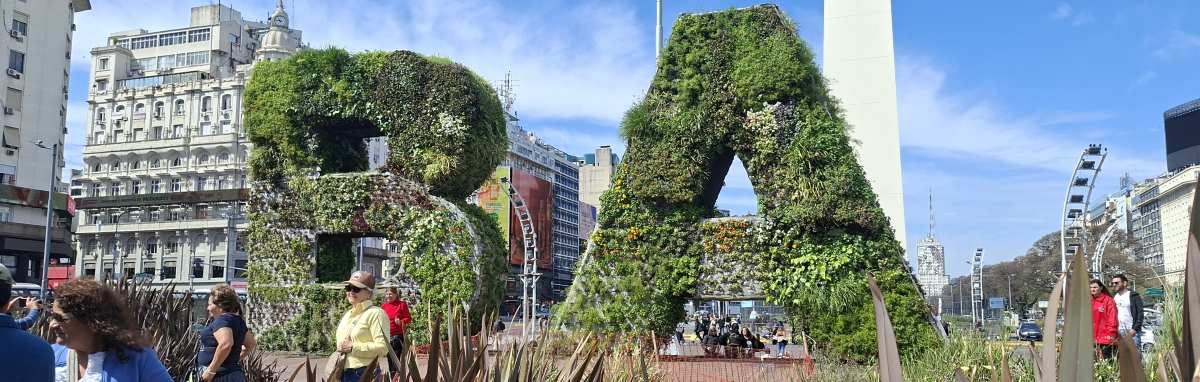
The exception is the riverside. Out past the restored warehouses of Puerto Madero, the Costanera Sur Ecological Reserve opens up hundreds of hectares of marsh, trees, and trails along the Río de la Plata, and it carries a surprising share of the load, about a fifth of the city's entire green space per resident. Without it, the average would sink even lower5, 6. There is an irony in all this. The city's most photographed patch of green may be the BA letters beside the Obelisco, six and a half meters of plants shaped into the city's initials, standing in a plaza with some small flower gardens around it.
Is Two Days Enough?
Buenos Aires is a very big city, so don't expect to see all of it in a few days. I had a full 2 days and explored the city center on foot. A third day would have been enough to see a bit more, the Japanese Garden, the Botanical Garden, and so on, but I really didn't feel like doing a third day here. As I've mentioned many times in many blogs – I don't care for big cities. So, visit BA and try to spend a few days here, you'll enjoy it.
References
- https://es.wikipedia.org/wiki/Buenos_Aires
- GaWC (Globalization and World Cities Research Network), Loughborough University. This is where the "alpha" classification actually comes from. In short, alpha cities are the most heavily connected nodes in the global economy, measured by the presence of major firms in finance, law, accounting, and advertising.
- https://www.kearney.com/global-cities/2020
- https://web.archive.org/web/20160206083434/http://www.lanacion.com.ar/1868566-argentina-son-realmente-los-portenos-los-parisinos-de-sudamerica
- https://nuevosbaires.com.ar/mapa-de-la-desigualdad-verde-en-la-ciudad-cuales-son-las-zonas-con-menor-accesibilidad-a-plazas-y-parques/
- https://puntoconvergente.uca.edu.ar/espacios-verdes-en-la-ciudad-solo-hay-513-m2-por-persona/

I used to teach English as a foreign language in Barranquilla, Colombia. Now I'm retired and traveling throughout South America.
I'm from Kennewick, Washington, USA. In my previous life, as I call it, I was an IT guy, systems administrator, computer tech, as well as a shipping/receiving guy and also worked as a merchandising guy in a RV/Camping store.