My Books on Amazon






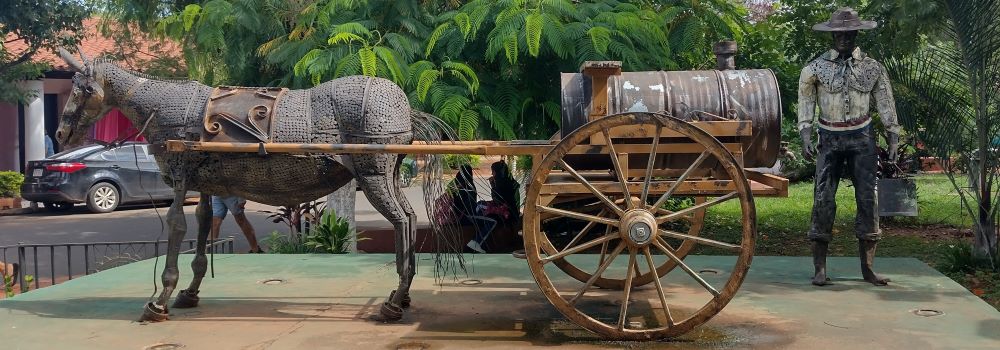
Itauguá, Paraguay
April 27, 2023
Itauguá, Paraguay, population: about 90,000. Itauguá is 30 kilometers (18 miles) southeast of Asunción. Itauguá was founded in 1728. For some years, Itauguá has been one of the fastest growing areas in Paraguay. Itauguá is famous for it's pottery, architecture, and folk music. The name, Itauguá, came from the local indigenous language Guaraní. Itauguá Being a bedroom community of Asunción one would expect it to be primarily urban as are the other similar towns around Asunción, but no, Itauguá is urban, productive rural, and natural. And I must say it is in a beautiful area.
The town was founded by the Spanish in the area where there had been numerous small camps beforehand. The Guaraní people had inhabited this area for countless years before that. The town grew from these small camps instead of around a central church, which was more common. The date itself is not exact, as no such record exists. A historian found an inscription on a beam in the church which read, "Buildt in 1766". It was in the 1960s that a month and day where chosen so the city would have a date for celebrating the city's anniversary. Throughout the 1700s, the growth rate was estimated to have been about 50 new inhabitants per year. Around 1800, the population was about 2796. Starting in 1811, the city created a grid system for the blocks and streets; prior to this time they had only irregular paths. They also constructed the first 'serial housing' units for families. I'm not sure, but I think that refers to 'townhouse' style houses. Some of these original houses still exist, some are museums and shops. In 1830, the original church was completely refurbished. Then in 1896, it underwent even further renovations which took 12 years to complete. The early 1900s saw a stagnation of the economy due to drought, a locust plague, and finally, the civil war in 1922. Finally, about 1940, the mayor got things turned around and starting developing and expanding the city, making many improvements.
Itauguá's economy is largely dependent on agriculture, pottery/ceramics, manufacturing, and commercial business, with a growing adventure tourism industry, mostly related to the pottery and ceramics.
Itauguá has a warm and temperate climate. The average daytime high of 28° C (82° F), and the nightly average low of 18° C (65° F). The city's elevation averages 170 meters (557 feet).
So, my impressions: While it may not have a central plaza with the church at one side and restaurants and shops on the other three sides, it is a very nice town sitting in a beautiful region. There are several large grocery stores/supermarkets, hospitals, and any other kind of shop you might want. And, it's only a short drive from the big city of Asunción. I like this town and, so far, all the others I have seen in this part of the country.
My goal is to find a new place to live. So to reach that goal, I am traveling most of South America, visiting the countries of Ecuador, Perú, Bolivia, and Chile, passing through Argentina, visiting Paraguay, passing through a bit of Brazil, and finally visiting Uruguay. I have a list of towns, about 70, that meet these qualifications: Cities with average day temperatures of 22-28° C (72-83° F) and night temps of 14° C (57° F) and higher; and a population between 28,000-300,000. I analyzed climate and population data of around 700 towns in the countries mentioned above and then pulled out the ones that meet the previously mentioned criteria, which leaves about 70. My preference leans towards towns of less than 100,000 people. And, now that I have visited more than 30 towns/cities, I've decided I will probably want an inland town. I love the beach and walking in the warm water, but getting sunburned is just too easy, even on a cloudy day. At least here in Ecuador. I've also decided that any town with more than 100,000 population will be too big. I've decided that any small town/city (less than around 80,000 population) that meets the temp specifications and has a supermarket and ATM is one worth considering to live in.
My goal is to visit the towns and discover which one calls out to me - "Chip, Chip, make your new home here, this is your new home town". That hasn't happened yet, but the seven towns listed below are very close to giving me that feeling. At any rate, I am not visiting tourist attractions or archeological sites, etc, those will have to wait for another trip through South America.
At this point in my journey, I have five towns on my Top 10 list - Tingo Maria, Moyobamba, La Merced, Perú, and Catamayo and Puyo, Ecuador. In my travels in Ecuador, I visited 32 towns/cities. In Perú, I visited 26 towns/cities; in Chile, only five towns; and in Argentina, I visited 13 towns.
Next up: Areguá, Paraguay.

I used to teach English as a foreign language in Barranquilla, Colombia. Now I'm retired and traveling throughout South America.
I'm from Kennewick, Washington, USA. In my previous life, as I call it, I was an IT guy, systems administrator, computer tech, as well as a shipping/receiving guy and also worked as a merchandising guy in a RV/Camping store.