My Books on Amazon






Baeza, Ecuador: Where the History Outgrew the Town
January 17, 2026
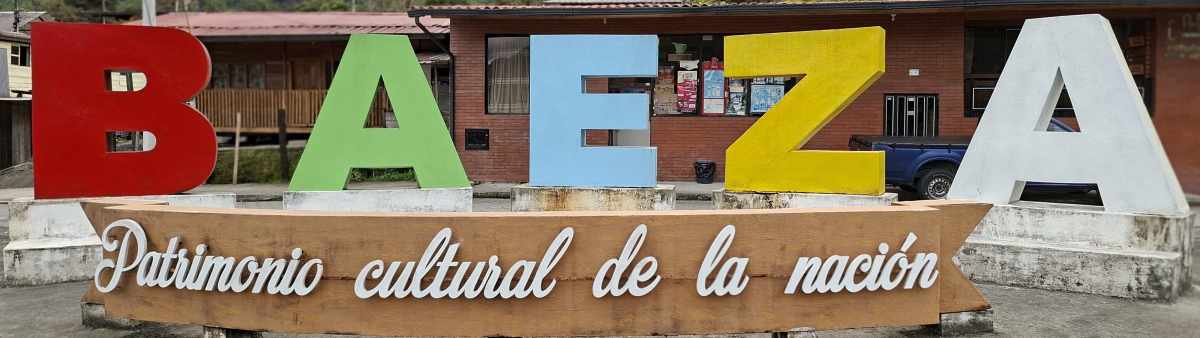
Baeza, Ecuador, sits in the lower slopes of the Eastern Andes Mountains in northern Ecuador. Sitting in a valley at an elevation of 1914 meters (6280 feet), this very small town of around 5000, was founded in 1559. Other than stopping for a meal, there's nothing here to see or do. There's a nature reserve a short drive outside of town, and looking at the Wikipedia page and its mention of a "municipal integrated farm" - well I didn't see any such thing in walking all over the tiny town, and Google maps shows "zoologico" which is typically a zoo or zoo-like place. Are they the same? I don't know, can't help you on that one. And there's the "Old Baeza" neighborhood just a few minutes walk out of the town proper. It's a neighborhood with its own church, a very unkempt "park" or plaza, maybe originally, a few hostals, and a tiny convenience store. At the front, alongside the highway, is a tiny park area with a couple of statues and the city name sign (pics in the photo album). It's all rundown, tired, and not at all what the Wikipedia describes it as.
History of Baeza
The history, and the Wikipedia page, of Baeza, is bigger than the town itself. So, here is a summarized version:
Long before the Spanish ever showed up, the valley where Baeza now sits was a living, breathing human place. Archaeologists digging into ancient lake sediments have found signs of farming and settlement going back at least 1,000 years, with maize, squash, charcoal, and other markers of steady human work buried in the mud. That tells us that long before any written records, families lived, planted, hunted, and traded here, connecting the high Andes with the rich Amazon basin. This was part of a vibrant indigenous world, long seasoned by centuries of life and movement.
Reference: National Geographic
Then came the colonial era. On May 14, 1559, the Spanish explorer Gil Ramírez Dávalos founded the city with its long ceremonial name, Muy Noble y Muy Leal Ciudad de Baeza del Espíritu Santo de la Nueva Andalucía, right on what had been Quijos-Quichua territory. That name, translates to: Very Noble and Very Loyal City of Baeza of the Holy Spirit of New Andalusia. Baeza quickly became one of the most important towns in the Ecuadorian Amazon during the 1500s and early 1600s. It was more than a little dot on a map; it was the administrative seat of the Governorate of Quijos, a launching point for expeditions, missions, and colonial reach into the rainforest.
Wikipedia
That colonial period was rough on the people who lived there before. Contact brought disease, forced labor, and conflict, and the indigenous population collapsed dramatically in just a few decades. Records and natural archives suggest that from perhaps 35,000 people in the region before Europeans, only about 11,400 remained clustered near Baeza by the late 1500s, and by around 1600 three-quarters of them were gone due to disease, exploitation, and fighting. Revolts did break out — including a major uprising in 1578 — but the toll was massive and the old societies were shattered.
Reference: Smithsonian Mag
After the colonial boom faded, Baeza faded with it. By the 19th century its importance as a regional powerhouse was long gone, and for a while only a handful of huts marked the old settlement. Over time, new Baeza grew back as a small administrative and commercial center for the Quijos Valley, and in 1995 the “old city” was officially declared a cultural heritage site for its role as a gateway to the Amazon. Today Baeza still wears its layered past on its sleeve — indigenous beginnings, colonial ambition, near-destruction, and a quiet modern life in the shadow of cloud forest and river.
Reference: Wikipedia
The Climate of Baeza
It's rather on the chilly side - the average daily high is 17° C (61/62° F) and the average nightly low is 8° C (47° F). So, even though it's much, much lower in elevation than the previous couple of towns I visited, it's still very cold.
My Impressions
First, this town is small, as you can imagine with less than 5000 people. There is one ATM, it's from one of the "cooperativo"-type banks. The problem, for me, anyway, is that none of the cooperativo banks' ATMs will accept my Schwab debit card. All the other regular banks in all of South America - no problem. So, not getting cash while in Baeza, bring cash with you. Also, most businesses here will not accept payment with a debit/credit card, so again, bring cash. And on that front - I at dinner at a chicken broaster place, it was five dollars, I gave the girl a twenty dollar bill, and she asked if I had anything smaller. Right, she didn't have fifteen dollars for change. She spoke to a woman in the restaurant, then left and came back with the twenty changed down. This is common in Ecuador - Unless you're spending at least ten dollars, don't expect to be able to pay with a twenty. The town is quiet except for the occasional tractor-trailer rig cruising through. This is not a place you would go out of your way to visit, it's a place you might stop for lunch, and that's the end of it.

I used to teach English as a foreign language in Barranquilla, Colombia. Now I'm retired and traveling throughout South America.
I'm from Kennewick, Washington, USA. In my previous life, as I call it, I was an IT guy, systems administrator, computer tech, as well as a shipping/receiving guy and also worked as a merchandising guy in a RV/Camping store.